People Make Glasgow: Notes on Care, Work and Who Counts as an Expert
Two sessions at the Global Intergenerational Congress (#GICscot26), and a film from Canada

Glasgow Queen Street (GLQ)
I began someone else's session with a confession.
A few years ago, Jessica Luh Kim and Allen Power came to visit Berlin, and I offered to show them the city. I walked them eighteen kilometres in one day. Jess, I told the room in Glasgow, still speaks to me.
That was how I introduced her: as the friend I nearly walked into the ground, and as the person who should have been standing where I was standing.
The expert who could not come
The session was Jess's idea. She is the expert here, in learning, in leadership, in care, and in her own life as a family care partner. She proposed that we build it together, she and an architect, because so much of the learning happens in between: between disciplines, between people, between continents. I said yes at once. It is how I most like to work.
Then she could not travel.
So we decided on a film. Jess recorded a ten-minute keynote, and inside it, three older adults she has worked with in Canada, two of them living with dementia.
I am an architect. That afternoon I was standing in for the expert. I felt honoured, and I knew I could never be Jess. That was why we chose the film: her voice, their voices, and me to hold the room.
Advisors and partners
Then the screen.
A man appears in a warm room, under a ceiling lamp. Beneath his name, the film says: advisor on educational resources and research.
That is Bill. After him comes Mary Beth, advisor on research, service and educational design. Then Susan, course partner.
Not residents. Not participants. Not a diagnosis. Advisors and partners, with titles, because that is the work they do.
Jess asked each of them a question. To Mary Beth: what changed, once you were a partner instead of a guest?
For decades, she said, the standard playbook has been the guest model:
"We are brought a 15-minute slot at the end of a semester, or a panel at a conference. We share a story, people applaud, someone says how inspiring it was, and then the class or project moves back to business as usual. We are treated as storytellers, not strategic figures. Decorative, not foundational."
As a guest, she said, you are asked again and again to open your personal life, to recount a difficult diagnosis or an institutional failure for the benefit of others. It can feel extractive. And then she described the change:
"When you are a thought partner, the focus shifts from what happened to you to what you know, and how we solve this together."
When the film ended, the room stayed quiet for a moment. People were thinking. Then slowly, poco a poco, the conversation began.
The only expert at the table
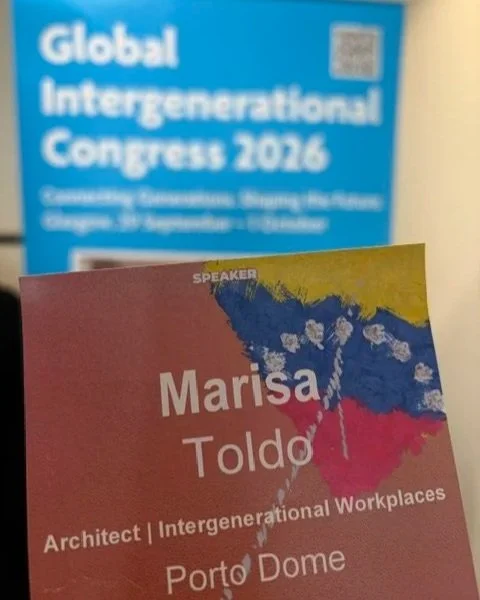
Conference days at the University of Strathclyde, Technology and Innovation Centre
In my own session that week, Working Across Generations, the expert was not in the room either. She was on a card.
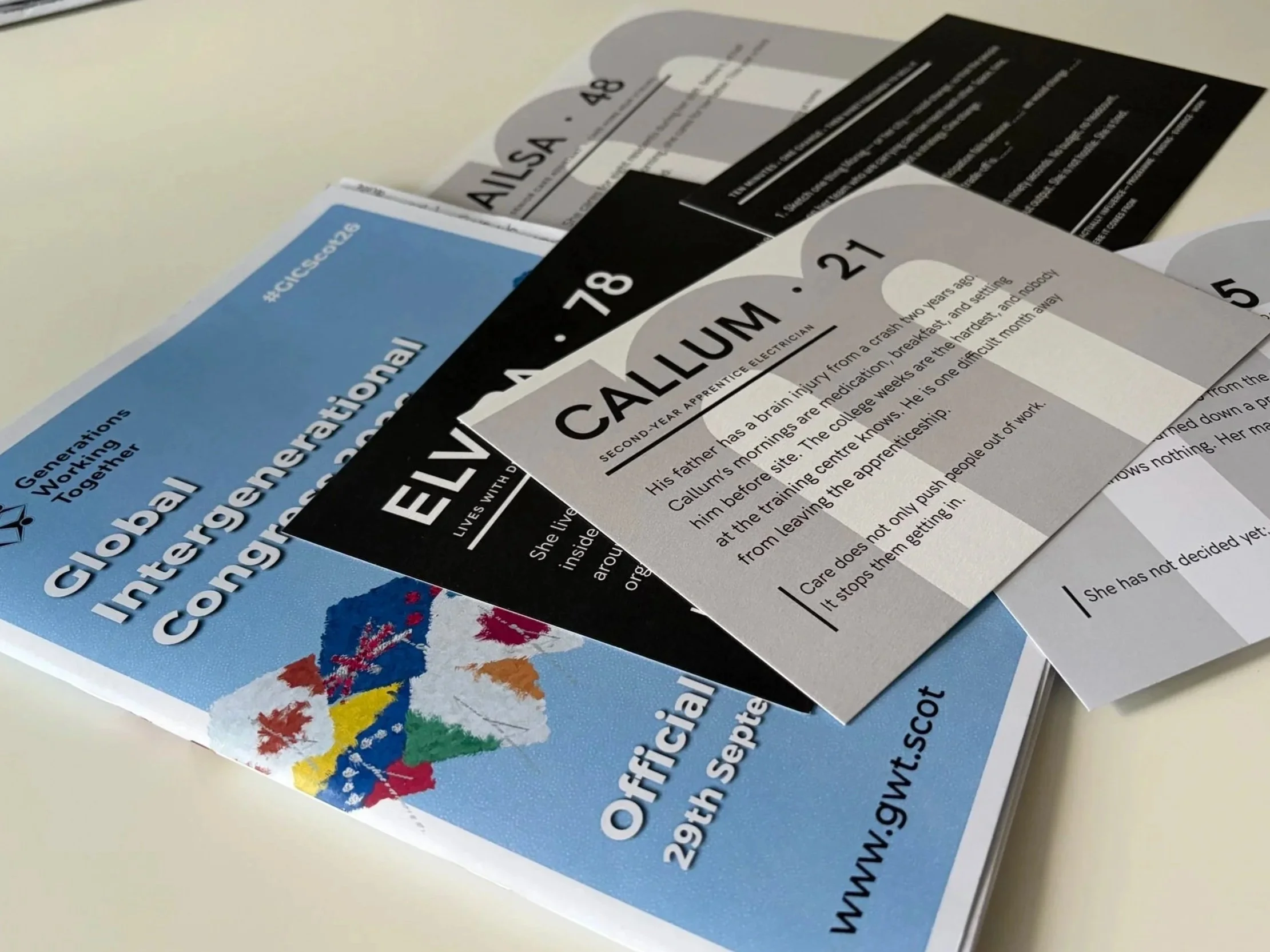
Every table received two cards, each a fictional person in six sentences. Then five questions about that person's ordinary week, ending with the one that matters most: who have they stopped seeing, and who has stopped seeing them?
People went deep. A CEO, a researcher and a volunteer at the same table, working codo a codo, elbow to elbow, for a person who does not exist. Nobody asked who held which title. For that hour, the only expert at the table was the person on the card.
You could feel it in the air. This was not the workshop people had expected. We rarely talk about care at work at all, and almost never with an architect.
What gets in the way
Jess's film named two obstacles. The first is an assumption that expertise comes from credentials, not from lived experience. The second is treating partnership as a programme, instead of a standing decision about who gets to shape the work.
That second line is the whole of my argument as an architect, said better than I usually say it.
And listen to the geography of what Mary Beth describes. The guest gets a slot at the end. The partner gets a seat at the table, at the beginning, when the questions are still being written. Partnership has an address and a time. That is something a building, a timetable and a brief can decide.
Contact between generations rarely fails for lack of goodwill. It fails because nobody designed it to be reachable. It becomes a programme, held together by one generous, tired person until she leaves, and then it is gone.
Bill, Mary Beth and Susan have titles because someone made a different decision, and then kept it.
And this is what my fifth question learned from them. When we ask who someone has stopped seeing, we imagine a loss to repair: a visit, an activity, a programme. Sometimes she is not missing company. She is missing a role. She has stopped being someone the world consults.
People make Glasgow

Glasgow’s statue-coning tradition started in the 1980s
People Make Glasgow. I used to read that as a slogan. After three days there, I read it as a description: big hearts and quick humour, sharp minds, and a kindness that does not announce itself. I came home a little in love with the city. I still am.
But the slogan has a second half that nobody prints. People also make it possible to reach each other, when someone designs the room for it.
So, the question Jess left behind, which I am still carrying: is there someone in your building who could be a partner in this work, and is still being treated as a guest?
If you find an answer, I would like to hear it. You can write to me.
With thanks to Jessica Luh Kim, who imagined this session and brought it to Glasgow from across an ocean; to Bill, Mary Beth and Susan, for sharing what they know; and to Generations Working Together, a small team with an outsized effect, who held three days for more than 160 people from 18 countries. Grazie. Gracias. Thank you. Key messages from my session also appear in Elevating IG Practice: Highlights from Global IG Congress 2026 on the Together Old and Young website.
P.S. The reachability check. If you want to try it with your team: one person, real, six sentences, no more. Forty-five minutes. Five questions.
What does their ordinary Tuesday look like?
Where in the working day does the care appear?
Are they closest to working more, caring more, or leaving?
What would make them worry less?
Who have they stopped seeing? And who has stopped seeing them?
Spend the longest on the fifth.