An Address for Liability
A machine can check a plan against a code. It cannot be struck off a register. On what happens to a profession when the rule-following goes elsewhere.
There is a list at the Architektenkammer Berlin with my name on it.
If my name came off it, I would not be allowed to call myself an architect. Not as a matter of courtesy or taste. As a matter of law. In almost every country the word is protected: the Architektenkammer in Germany, the ARB in the United Kingdom, the Ordine in Italy, the Colegio in Venezuela. You may do the work, you may draw the drawings, you may be brilliant at it. You may not use the word.
I have been asked more times in the past year than in the twenty-five before it whether a machine is going to take this profession away from me.
The question is usually asked kindly and it deserves a better answer than the two on offer, which are that everything is fine and that everything is over.
What is actually moving
The parts of my profession that follow rules are exactly what machines do well.
Checking a plan against a code. Producing a specification. Screening a scheme against regulation. Assembling a brief from a template. Comparing a design to a hundred precedents and telling you where it deviates. These are getting good quickly, and anyone in practice can feel it. I have watched this kind of check happen in minutes where it used to cost a junior a full afternoon, and cost the practice a fee line to match.
It is no longer one tool doing one job, either. Increasingly it is a set of agents talking to each other, one measuring, one drafting, one checking the last one’s work, with a person stepping in mainly when two of them disagree. That is only going to get faster, and I do not think it should be resisted.
I am not going to tell you where it ends. Nobody knows, and everybody’s forecast is worth the same, which is nothing. I have read the confident ones from both directions and they are indistinguishable in their confidence.
What I notice is narrower and I am fairly sure of it.
Those were the parts of architecture we could most easily explain to a client and most easily put on an invoice. They are legible. They have deliverables. You can point at them.
What remains when they go is the part we were always worst at describing. What a room does to a person over a long afternoon. Whether a lift lobby built for a wheelchair also works for a pushchair and a delivery trolley at the same hour of the same morning. What a memory-care wing needs from its light at four in the afternoon, which is not what it needs at any other hour. What an eighty-eight-year-old can navigate without having to ask anyone for help, and what that asking costs her.
We never valued that part properly, partly because we could not itemise it. We are about to find out what it is worth.
Why the profession does not simply dissolve
When I first moved to Germany, a friend introduced me to her father over coffee. An architect of an older generation, being kind to someone new in the country.
He told me that we architects walk with one foot outside the jail and one foot in. It was generous of him to put me at his level before I had earned it.
Mit einem Bein im Gefängnis. With one leg in prison. It is an ordinary enough saying in German, used about the professions that carry liability, and he said it the way you say a thing everyone in the room already knows.
He was not being dramatic. He was describing the liability the way people inside a profession describe it to each other, before anyone reaches for the legal language.
And here is the unromantic reason I keep coming back to his sentence instead of the romantic ones.
A building can kill someone. When it does, there has to be a name.
Somebody who signed. Somebody who can be asked what they knew and when they knew it. Somebody who carries professional indemnity insurance, who can be taken to court, who can lose their licence and with it their right to the word.
That is what a licensed profession actually is. Not a guild, not a club, not a tradition. An address for liability.
The protection sits in the title itself, which is why the title is protected. It is not a description of what you do. It is a declaration that somebody has agreed to be answerable, and that the answerability can be taken away from them.
A model cannot hold indemnity insurance. It cannot be struck off a register. It cannot sit in a room and be asked why it did that, and it cannot be changed by the answer. Ask it why the corridor is a metre too narrow and it will apologise, offer three fixes, and forget the entire project by morning, ready to make the same mistake for somebody else’s client tomorrow. That is not a character flaw. It is also not a profession, because a profession is exactly the thing that is supposed to remember, and to pay for it when it does not.
So the work will change, probably a great deal, and the person who has to answer for it does not go away. What changes is what that person spends their judgement on.
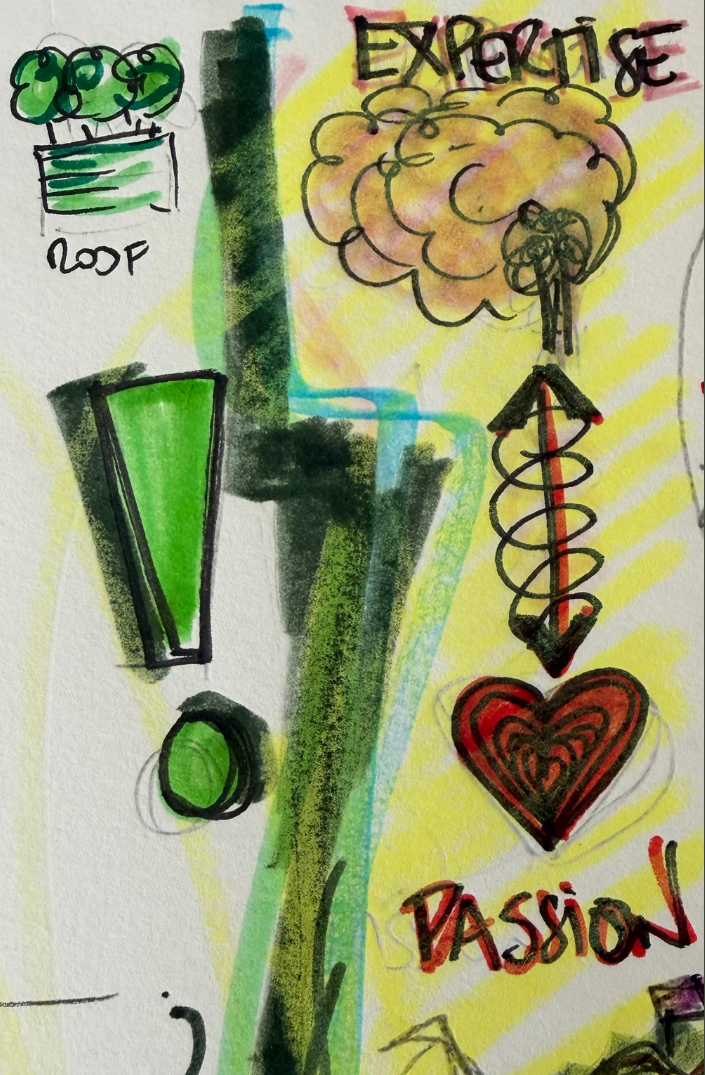
Sketch by the autor
The part that does not automate
I would rather it were spent on the brief.
A machine will become very good at answering the questions a brief asks. It will check the fire strategy, run the daylight, flag the clash, cite the regulation, and it will do all of it faster and more consistently than I can.
Somebody still has to write the brief.
And the brief does not stay still. It grows for technical reasons, for budgeting reasons, for political ones, often at the same time and rarely because anyone asked for more. In a refurbishment that growth turns physical. You can assume what an old building has, and in Europe you are almost always dealing with an old building, but there is reliably a surprise once you open the walls, and it usually lands squarely on the sustainability numbers the whole scheme was sold on. A model can flag the discrepancy the moment someone finds it. It cannot decide, in the room, what that discrepancy now costs and who is going to carry it.
And more than that: somebody has to notice what the brief does not ask. That is not a computation. It is a question about who was in the room when the requirements were written, and who was not, and which human facts were left off the list because nobody at that table was carrying them.
I have watched buildings go wrong for that reason many more times than I have watched them go wrong for a technical one. The drawings were correct. The brief was incomplete, and everything downstream inherited the omission and made it permanent in concrete.
None of that writes the brief that has to hold a frightened person, or a grieving one, or an eighty-eight-year-old who wants to keep her dignity intact on the way to the bathroom at three in the morning. Somebody has to imagine that person before the drawings exist. And somebody has to be answerable if they imagined her wrong.
That is the work I want to keep. Not because a machine cannot do it. Because when it is done badly, someone has to be answerable, and a register is the only place we have ever found to put that.
If you are writing a brief, or about to have one written for you, and you are wondering what it might be leaving out, I would like to hear about it. You can write to me. I answer.
This is part two. Part one, Hechos Humanos, is about the four facts a brief should be answering