A Morning Already Drawn
From Care Is Infrastructure*, an official satellite event of the New European Bauhaus Festival 2026 on work, care, and the generations we have learned to keep apart.*
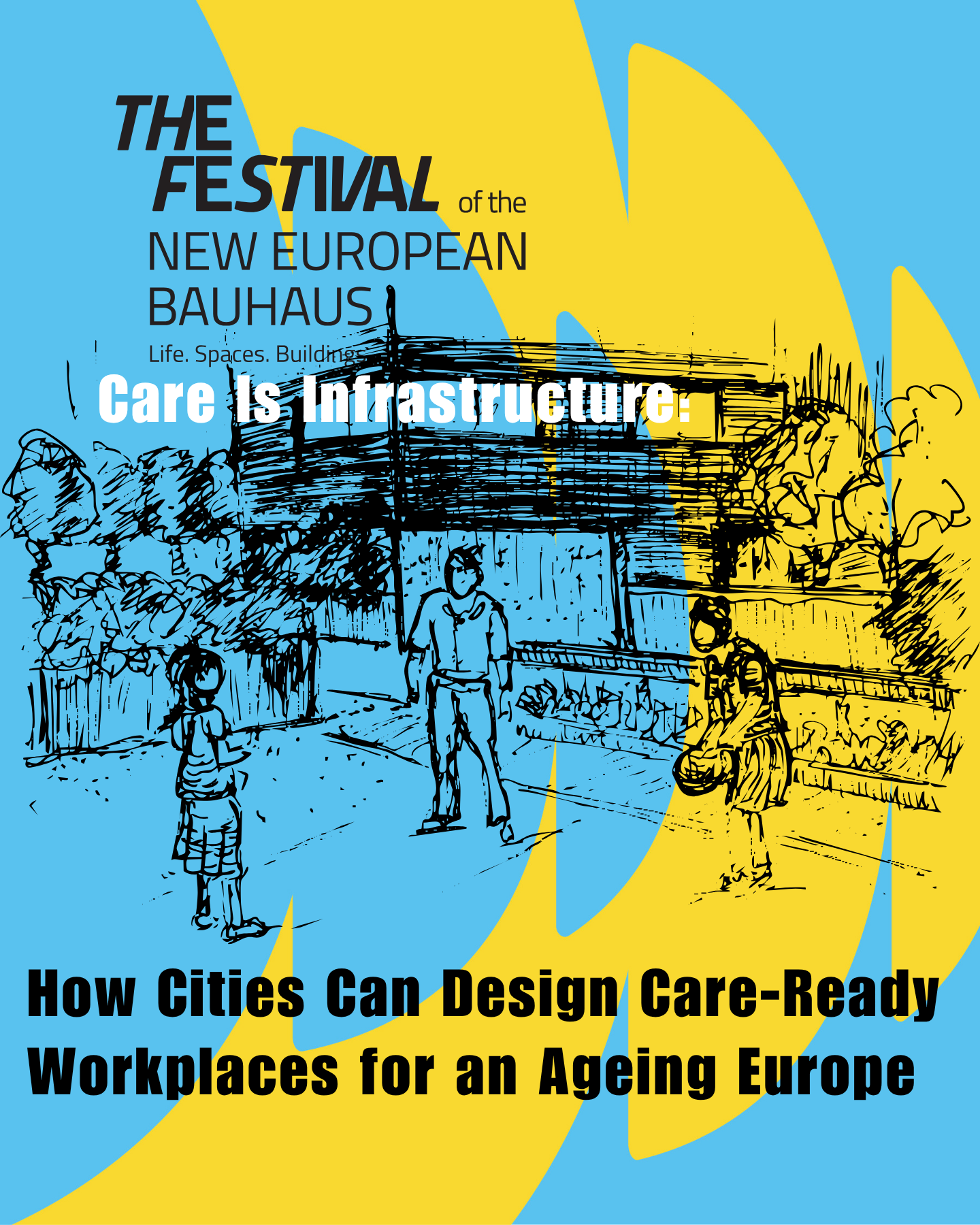
What if your child rode in with you, your father arrived later with friends, and a shared space waited between their separate rooms?
That morning is not utopia. It is a design choice.
I convened Care Is Infrastructure on the tenth of June, as an official Satellite Event of the Festival of the New European Bauhaus 2026, to set out the architecture this morning needs. I am an architect. I was trained to read a structure for its load paths and its thresholds to know what it can carry, and where it will fail.
The event asked that question of a structure we almost never name as one. The workplace and the everyday spaces of the city built to keep it apart from the rest of a life.
Modernity, as a project of separation
For two centuries, modernity has been a project of separation.
We took the things human beings once did within sight of one another and filed them into distinct buildings, distinct zones, distinct hours of the day. Children to the school. Adults to the office. The old to the residence. Each typology more refined than the last, each one more efficient, each one more sealed.
We called the result progress. Much of it was distance.
Then something quiet and new arrived. Four and even five generations now share the same floor in workplaces across Europe for the first time in recorded history. A demographic accident, undesigned, that has placed our most important social experiment in plain sight.
Sharing a floor is not the same as belonging
Here I must be precise, because the whole argument turns on a distinction that is easy to miss.
To share a space is not to be connected.
A multigenerational workplace is a fact — people of different ages who happen to occupy the same building. An intergenerational workplace is an intention — one in which those people mentor, learn, build, and grow older alongside one another, on purpose.
The first is a coincidence. The second is architecture.
The distance between them is what I came to ask about.
The labour that holds everything up
One figure stays with me.
In Europe, around four-fifths of all long-term care is provided not by institutions but by families — by unpaid carers, roughly two-thirds of them women, holding a parent, a partner, a child. One working-age European in three already carries some responsibility of care.
We file this labour under the private, as something that happens off the plans.
It is not private. It is load-bearing. Remove it, and the ordinary edifice of working life would come down by the afternoon.
The load is not carried evenly. Among Europeans with caring responsibilities, nearly four in ten women say their careers have suffered for it — more than twice the share of men. The pattern is not only ours: a Harvard Business School study found almost three-quarters of American workers carry some form of care. The labour that sustains the economy is quietly subtracted from the lives, and the earnings, of the people who provide it. Mostly women. Mostly in the strongest years of their working lives.
Who carries it and when
Researchers here in Berlin recently published something that should change how we read those numbers.
Following care across Europe for nearly two decades, they found that even the age at which caregiving begins is not random. It is socially patterned by gender, and by the kind of work a person does. Women, and people whose work is already undervalued, are drawn into care earlier in their lives.
Hold that beside what we already saw. The care penalty is not only unequal in who pays it. It is unequal in when it begins.
That is the harder question. It will not be settled here.
The New European Bauhaus asks us to build a future that is beautiful, sustainable, and together. But no city is together while it treats the care that sustains it as a soft luxury, a private arrangement, a thing for someone else to resolve at home.
To leave care off the drawing is not an oversight. It is a design failure.
Here is an argument that sounds, at first, like a metaphor, and is not one. The workplace — and the everyday spaces of the city around it — is infrastructure. Not a perk, not a wellness session offered on a Friday, but infrastructure, in the same grammar we keep for bridges and water systems: the thing a society cannot function without. A city does not become resilient by adding care at the end. It becomes resilient by building care in. The European Institute for Gender Equality has begun to describe care in almost the same words. We already spend the better part of our lives inside these spaces. They already decide who has time, who has flexibility, who carries what.
To call them infrastructure is only to admit what they have always been.
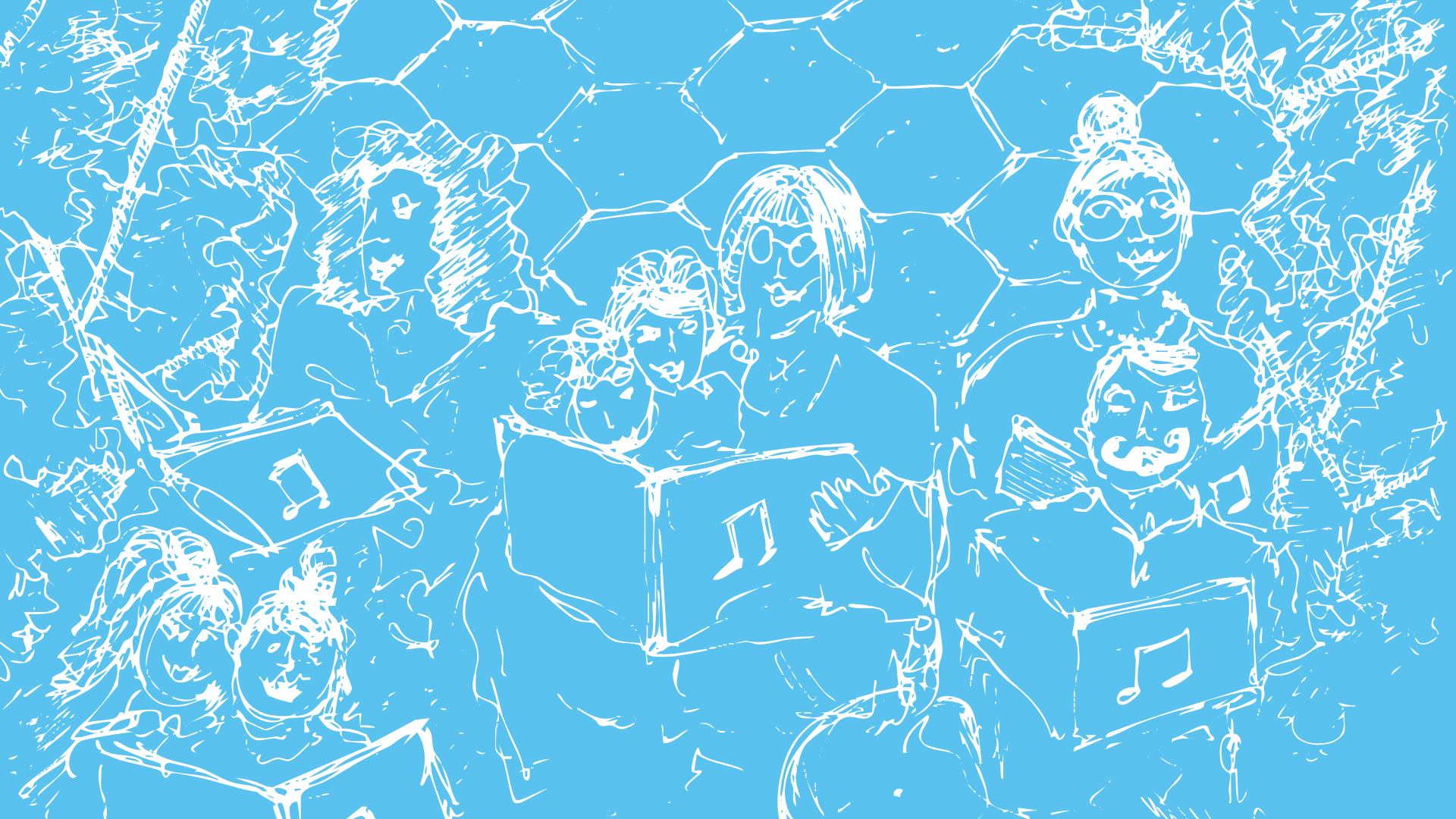
Sketch by the author.
The city already has the rooms it needs
This is the work I have begun, under the name Porto Dome: to retrofit the workplace into an intergenerational hub, where the care of children and of elders is woven into the working day, instead of scattered across a city built to keep them apart.
The city does not need more buildings. It needs to re-read the ones it has. And two kinds of room are already waiting.
The first is the emptying office. Floors are going dark across Europe, and an empty floor is not a loss — it is a question left unanswered. To place the care of children and elders inside one, walkable from where the day's work happens, is not to build something new. It is to reuse what already stands — and nothing we could build would be greener than the floor that is already there, its carbon long since spent. That is what circular can mean — not only materials, but hours.
The second room is less obvious, and more honest. The places where care already gathers are not only corporate towers — they are hospitals, universities, municipal offices, the buildings of the care operators themselves. Workplaces staffed, overwhelmingly, by women: the nurse, the cleaner, the ward clerk, the administrator who keeps a department running while keeping a parent alive at home.
There is a quiet cruelty in that arrangement. The institutions that produce care for a whole society are often the worst at keeping any for their own. To bring a hub inside a hospital or a university is not to carry care into a foreign place — it is to let a building that already runs at the tempo of care hold some of it back for the people who give it. And to be worth anything to them, it must keep the hours they actually keep — the early shift, the late one, the night — not only nine to five.
Reused floor or caring institution, the gesture is the same: to close the distance between the scattered places where a life is actually lived.
A constellation, not a soup
This is the part of the design that needs to be said carefully, because it is the part most often misunderstood. A hub like this is not a soup. It is a constellation.
Each generation keeps its own room. The children have a place that is theirs: sized for their bodies, lit for their attention, paced for their day. The elders have a place that is theirs: its quiet, its proportion, its slower clock. The working adults have desks, meetings, the ordinary architecture of a productive day. None of these spaces is asked to perform someone else's life on top of its own.
And between them, one shared space. A library, a garden, a generous kitchen, a club the name matters less than the function. This is the space where a four-year-old and an eighty-year-old end up at the same low table, because the building has made that encounter findable, not mandatory. The most powerful places are the ones people choose to enter. The shared space earns its weight by being optional.
A hub like this does something a single building was never asked to do: it holds several speeds at once. The working day keeps one tempo, a child another, an elder — most of all a person living with dementia — a third, slower one. That slowness is not a failure to keep up. It is a rhythm the city was never built to admit.
To let these clocks run side by side, each in its own room, with a chosen place where they meet, is not a kindness added at the end. It is the architecture itself doing the work of dignity.
Beauty as legibility
Dignity is also a question of how a room is made, which is where beauty stops being decoration.
Daylight. Plants. Natural materials. A window onto something living. Calm sound. Clear sightlines. A space legible at a glance.
None of this is softness laid over the structure. For a child it shapes attention; for a recovering body, sleep; for a person living with dementia, it can decide between orientation and fear. Beauty here most often means less, not more. For a hundred-year life, beauty is legibility, and legibility is dignity.
The children cease to be an interruption. The elders cease to be alone. The cuidado — the everyday tending I grew up with in Venezuela, the Spanish word for the daily, ordinary care of one another — that was invisible becomes visible.
And once a thing is visible, it can at last be designed for.
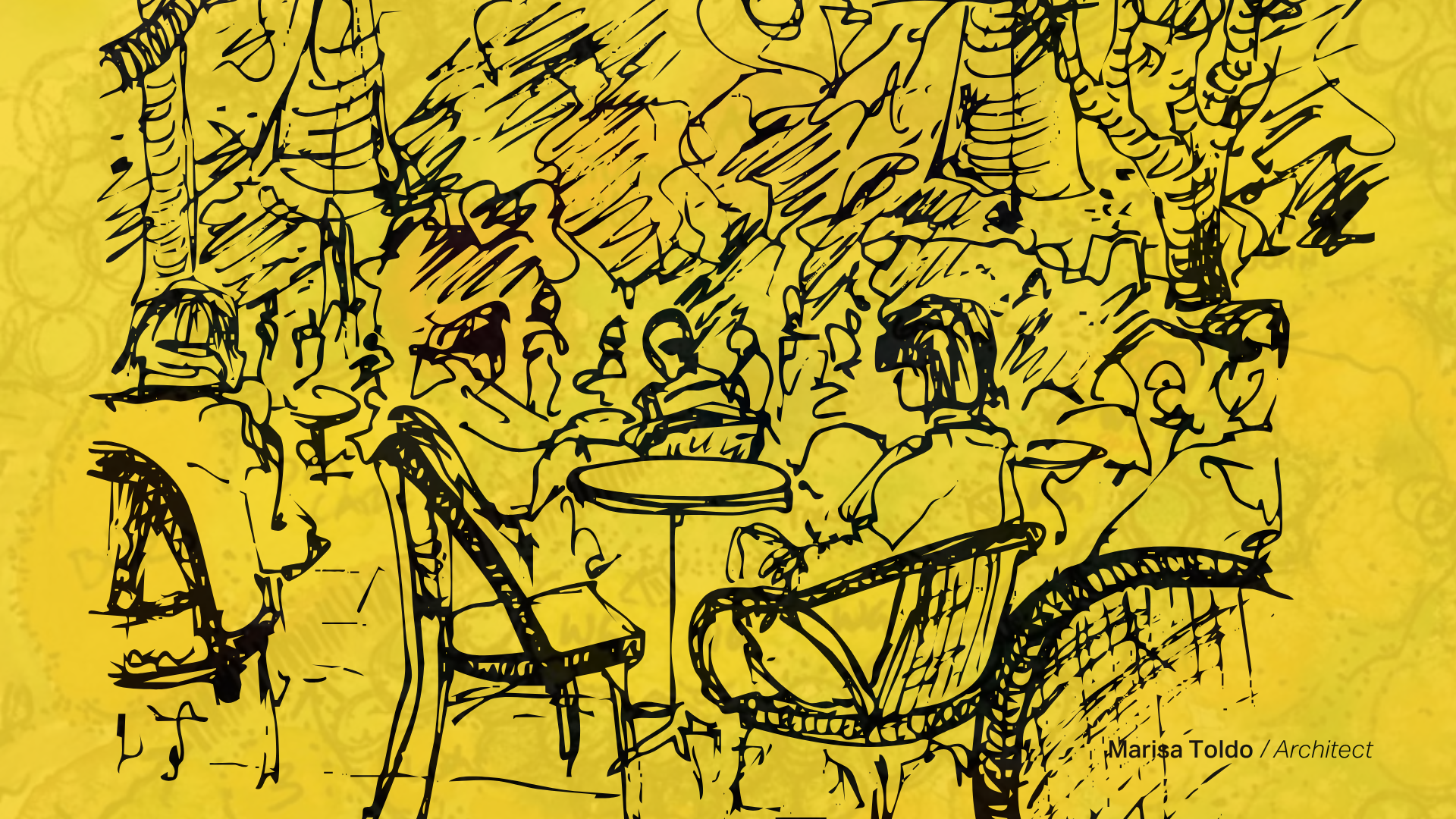
Sketch by the author.
The morning is already drawn
I did not bring answers to that satellite event. I brought the conviction that a question, asked slowly and held openly, is itself a form of construction. So I will leave here the one I keep returning to, open, as I left it then:
Where do you place yourself in this morning not as a category, but as a person?
The morning is already drawn. We only have to build it.
Marisa Toldo
If this is your question too whether you lead a city, shape a workplace, or simply carry one at home the conversation continues, at the next gathering or simply by writing to me.
Care Is Infrastructure: How Cities Can Design Care-Ready Workplaces for an Ageing Europe — an official satellite event of the New European Bauhaus Festival 2026, held online on 10 June 2026.