Designing Work for Europe's Longevity Society: From InvisibleCosts to Competitive Advantage
A False Choice
On April 08, 2018, I faced the choice no daughter should face: my career or my father's care.
He was living with dementia, and the system made it clear: you can show up at work, or you can show up for him. Not both.
This is not just my story. It is the story of millions across Europe.
We have built workplaces that pretend care does not exist. And yet, the economy already runs on care. We simply refuse to see it.
How We Got Here: The History of Work Without Care
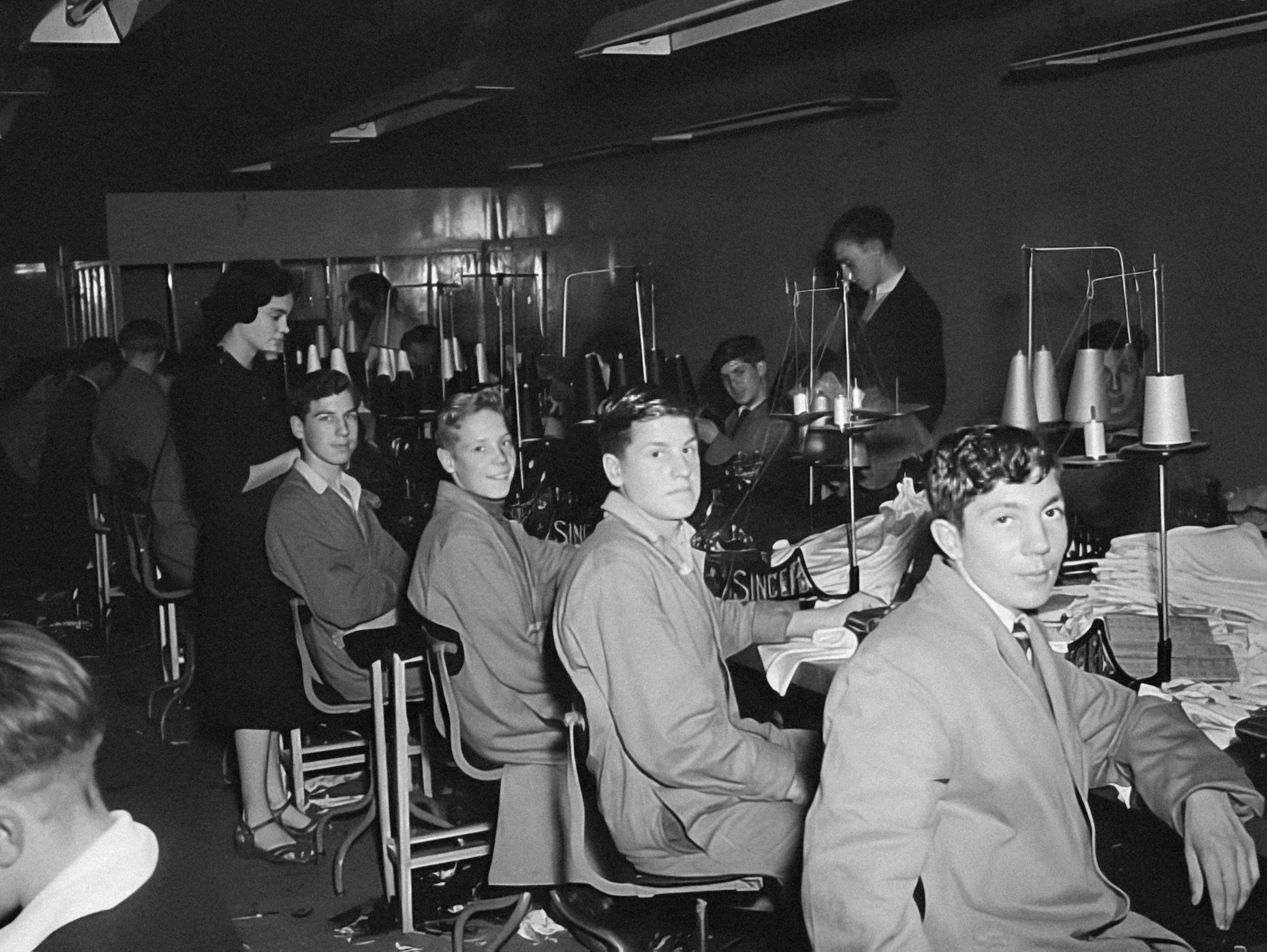
Every era in Europe has redesigned workplaces always for productivity, rarely for care.
• The Industrial Revolution gave us factories: rigid schedules, repetitive tasks, humans as extensions of machines. Productivity soared, but family and community were pushed outside the gates.
• The Post-War Welfare State rebuilt Europe with new ideals: dignity, equality, transparency.
Offices reflected this - narrow buildings where everyone had access to daylight, cellular layouts that embodied fairness. But the design assumed women were at home providing unpaid care.
• The 1970s Combi-Office in Scandinavia balanced private rooms with communal areas, mirroring societies striving for openness. Yet "the worker" was still imagined as care-free.
• The 1980s-1990s Open Plan pushed by IT and Taylorism flattened offices into efficiency machines. Flexibility grew, but the individual became smaller, more fragmented.2
• The 2020s Hybrid Era blurred home and work, accelerated by COVID- 19. Remote work offered flexibility, but also new strains: cognitive overload, disconnection, fragmentation. The rise of the 4-day week further disrupted rhythms - yet schools, nurseries, and eldercare systems remain on 5-day schedules.
And now, Al. It will transform industries. But let's be clear: Al can read scans, but it cannot comfort patients. It can process payroll, but it cannot hug a child or guide an elder through dementia.
Every redesign of work has pursued efficiency. None has redesigned it for care. That is the failure Europe must now correct.
The Scale of the Challenge
The numbers are stark:
• In Europe, 76 million non-professional caregivers, 12.7% of the population provide informal care every day. The value of this work is estimated at €576 billion annually, equivalent to 3.6% of EU GDP.^1
• Eurostat data show that in 2018, 106 million adults of working age (18-64) – fully one in three Europeans – reported care responsibilities, whether for children, dependent relatives, or both.^2
• The employment effects are stark: 39% of women with care responsibilities report negative career impact, compared with 17% of men.^3
• Recent studies illustrate the hidden costs: in the Netherlands, the total costs of informal care were estimated between €17.5 and €30.1 billion annually, of which 12-17% were indirect costs such as lost work and temporary career exits.^4 Extrapolated to Germany, this amounts to €70-120 billion annually, with €8-20 billion in indirect workforce costs –comparable to the output of the publishing or advertising industries.
Care is not marginal. It is structural infrastructure of the European economy but remains invisible in national accounts and corporate strategies.^3
The Invisible Care Penalty

Economists call it the "aging parent penalty" After a parental health shock, daughters employment in Southern Europe falls by 8.5% relative to sons', a gap that persists for years.^5
Across Europe, traditions of care differ:
• Family-based models place more responsibility on households, often women.
• Market-based models rely on private provision, creating cost pressures and unequal access.
• Government-based models invest in universal systems, buffering families from shocks.
Each model carries strengths and challenges. The task now is to learn from all three and design
resilient hybrid approaches that sustain both equality and productivity.
The Myth of the Standard Worker
Despite this evidence, most workplaces still operate as if life happens elsewhere.
But reality looks like this:
• Parents juggling three-month school holidays with full-time jobs.
• Adult children using "sick leave" to manage dementia care.
• Middle-aged workers the "sandwich generation" supporting both children and parents during their most productive career years.
Leaders who ignore this are not protecting productivity. They are exporting costs onto families, women, and public budgets.
Why This Matters for Democracy
Demography is not only economics. It is politics.
When citizens feel abandoned between impossible work and impossible duties, trust in institutions collapses.
Intergenerational solidarity frays.
Extremist voices gain ground by exploiting this frustration.
The intergenerational contract, the foundation of the European project, cannot survive if we continue to ignore the care crisis at the heart of work.4
The EU's Partial Response

The European Care Strategy (2022) was a vital step.^6 It revised the Barcelona targets to ensure:
• 50% of children under 3 in childcare by 2030.
• 96% of children aged 3 to school age in early education.
• Expansion of affordable, quality long-term care.
It builds on the Work-Life Balance Directive (2019/1158/EU),^7 which introduced minimum standards for parental leave, carers' leave, and flexible working. It also complements the European Pillar of Social Rights Action Plan (2021),^8 which highlights care as a pillar of fair labour markets.
But implementation is slow and uneven:
• In 2018, only 28% of parents with childcare responsibilities used formal services.^9
• Access varies drastically: Denmark exceeds 50%, Spain and Italy remain below 20%.
• Nearly half of people aged 65+ with long-term care needs report unmet needs.
Without acceleration, the EU will miss its own targets - and leave millions unsupported.
From Cost to Competitiveness
The economic case is overwhelming:
• Companies offering childcare see strong returns in retention and productivity gains.^10
• At the macro level, evidence from the Netherlands shows that the total costs of informal care ranged between €175 and €30.1 billion in 2019. Of this, 12-17% were indirect costs, such as lost working hours or temporary career exits.^4
• Across Europe, 27% of employees with care responsibilities adapt their work - through reduced hours, job changes, or family leave.
Every euro not invested in care is a euro lost in productivity.
Care is not charity. Care is hard infrastructure for Europe's competitiveness.5
The Porto Dome Vision and Mission
I developed the Porto Dome model not only as an architect, but as a daughter.
After caring for my father while trying to sustain my professional work, I realised the problem was not individual resilience. It was missing infrastructure.
Porto Dome is the infrastructure I wished I had and the one Europe’s workforce needs now.
The vision is simple but radical: integrate care, work, and daily life instead of separating them.
Imagine a world where business-organized intergenerational day care services have become the norm.
In this world:
• Parents – especially women – are freed from the impossible double burden of full-time work and caregiving.
• Older adults are less lonely, supported with dignity, and enjoy time with children.
• Children learn and play with elders, developing empathy, respect, and resilience.
• Companies benefit from a stable, skilled, and satisfied workforce.
• Insurers and public health systems save by reducing sick leave and delaying costly institutional care.
• Daycare providers evolve into intergenerational hubs, developing pedagogical concepts that enrich all ages.
This is not a dream. It is a design choice.
The World Health Organization (2023) adds that intergenerational contact is one of the three proven strategies to combat ageism - alongside policy reform and education.^11
By embedding intergenerational practice into workplaces, the EU can directly tackle loneliness, ageism, and workforce shortages in one integrated model.
What Is Intergenerational Practice?
The Beth Johnson Foundation (2009) defines it as:
“Intergenerational practice aims to bring people together in purposeful, mutually beneficial activities which promote greater understanding and respect between different generations, and contributes to building more cohesive communities. It is inclusive, building on the positive resources that the younger and older generations have to offer each other and those around them.” ^11
Intergenerational practice is not sentimentality. It is strategy. It is about designing workplaces and communities.6
Provocations: Where This Could Land in Europe
Let's provoke a little. Where could care-integrated workplaces land today?
• Public Institutions: Governments are among Europe's largest employers, majority female, with underused buildings in prime locations. What if ministries, regional offices, and EU institutions integrated daycare, eldercare, and shared intergenerational clubs?
• Hospitals: By 2030, Europe faces a shortage of 4.1 million healthcare workers.^12 What if hospitals became care hubs for staff as well as patients?
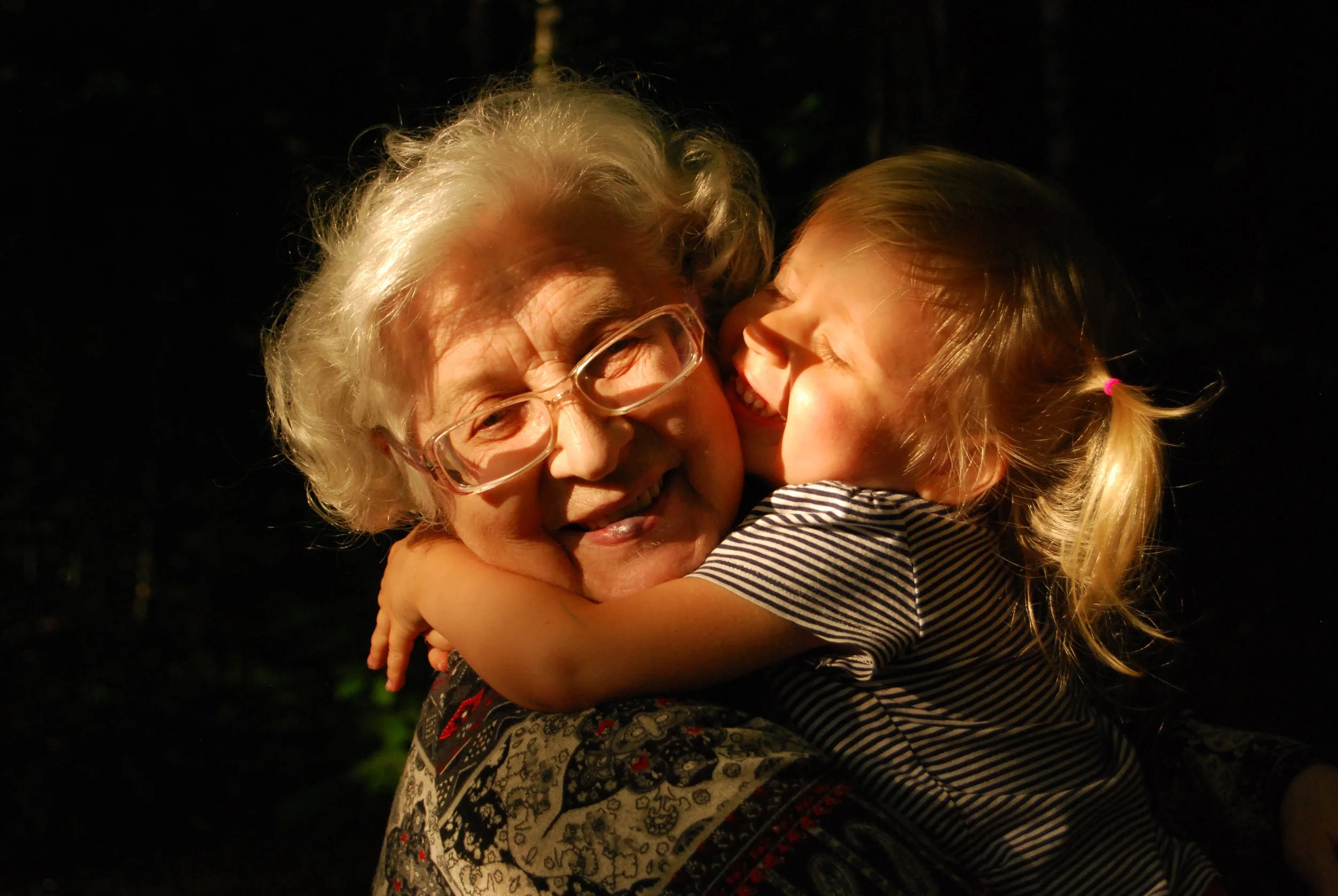
Why intergenerational?
Because loneliness is killing us. One in four older adults in Europe reports feeling lonely most of the time. ^13 Young people, too, face record isolation post- pandemic. ^14 Shared spaces across generations are a proven antidote. ^15
The Porto Dome Moonshot
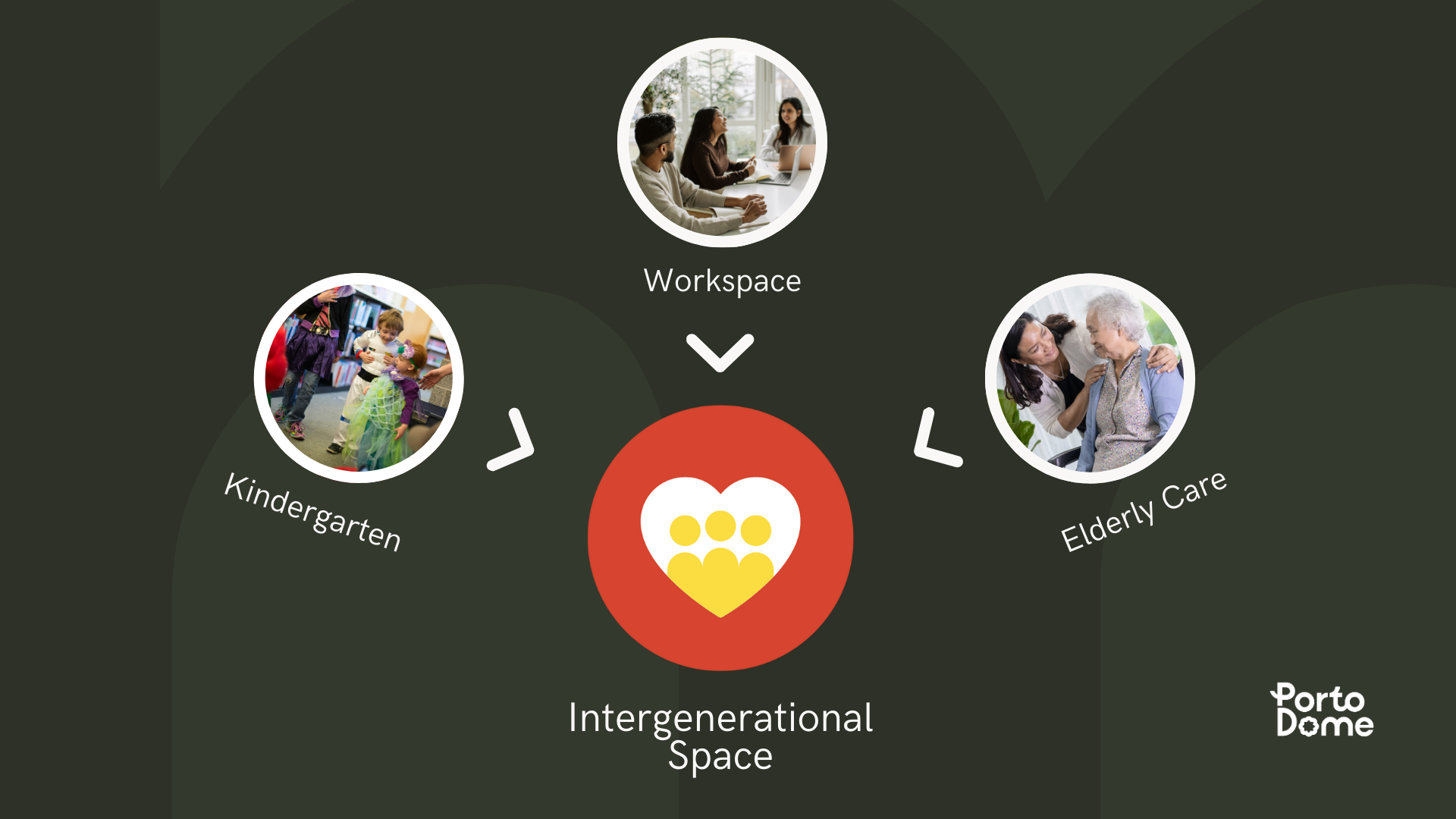
Porto Dome is a care-integrated workplace model that brings together:
early childhood care
daytime elder support
intergenerational shared spaces
proximity to work environments
Care, work, and daily life operate in proximity rather than separation.
Intergenerational practice is not sentimentality. It is strategy.
From Vision to First Pilot
Porto Dome is no longer a distant vision.
It is a model in active development and it is now seeking its first implementation pilot.
The concept has been shaped through lived caregiving experience and refined in collaboration with care and health specialists, educators, anthropologists, and social scientists. In parallel, I am in active exchange with municipalities, public administrations, employers, and insurers who recognise the urgency of retaining skilled workers in a longevity society.
What is missing is not insight or design. What is missing is a place willing to go first.
The first Porto Dome pilot is intended as a real-world implementation: a care-integrated workplace ecosystem that brings early childhood care, daytime elder support, intergenerational shared spaces, and proximity to work into one operational model.
The objective is pragmatic and urgent:
stabilise workforce participation in the 40–60 age group
reduce absenteeism and informal care-related exits
test governance, financing, and spatial configurations under real conditions
generate evidence for replication and scaling
Porto Dome is designed as an adaptable and licensable model, but it must be proven in practice. The first pilot is the bridge between system failure and systemic change.
Porto Dome
Policy Levers for the European Union
To make this systemic, the EU must:
1. Incentivise Care-Integrated Workplaces
Use EU funding streams — Recovery and Resilience Facility, Cohesion Funds, European Social Fund Plus (ESF+), Horizon Europe - to co-finance pilots. Offer tax credits and ESG recognition for employers who retrofit spaces.7
2. Close the Data Gap
Mandate Eurostat to track care-related workforce losses as a standard labour indicator. Today, absenteeism due to caregiving is buried under "sickness." Making it visible would force action by finance ministries.
3. Accelerate Barcelona Targets
Monitor not just enrolment but also hours aligned with working lives. Ensure provision extends to rural and industrial regions, not just capitals.
4. Reimagine Long-Term Care
Move from institutionalisation to community-based intergenerational models. Scale pilots across member states. Embed them in EU social investment policy.
5. Make Care a Pillar of Industrial Strategy
Place care alongside digitalisation, energy, and green transition as a core pillar of European competitiveness. Care is economic infrastructure, not just social policy.
An Urgent European Opportunity
Europe does not lack strategies, white papers, or long-term targets.
What it lacks are implemented prototypes that translate demographic reality into functioning infrastructure.
The Porto Dome pilot is conceived as such a prototype not a showcase, but a working system embedded in everyday life.
If we continue to treat care as a private issue, demographic change will quietly drain Europe’s skilled workforce and deepen inequality.
If we act now with concrete pilots Europe can lead globally by designing competitiveness around dignity, care, and social resilience.
The question is no longer whether this model is needed.
The question is: who is willing to implement it first?
References
World Health Organization. (2023). Supporting informal long-term caregivers (WHO Centre for Health Development, Kobe). World Health Organization. https://wkc.who.int/resources/news/item/01-10-2024-supporting-informal-long-term-caregivers-for-older-peopleEurostat. (2019). Reconciliation of work and family life - Statistics. https://ec.europa.eu/eurostat/statistics-explained/index.php?title=Reconciliation_of_work_and_family_life_-_statisticsEuropean Institute for Gender Equality. (2022). Gender Equality Index 2022 - The cost of unpaid care. https://eige.europa.eu/gender-equality-index/2024Elayan, S., Angelini, V., Buskens, E., & Boer, A. (2024). The economic costs of informal care: Estimates from a national cross-sectional survey in the Netherlands. European Journal of Health Economics, 25(8), 1311-1331. https://link.springer.com/article/10.1007/s10198-023-01666-8De La Vega, N., & Federman, S. (2024). The aging parent penalty across countries. SSRN. https://papers.ssrn.com/sol3/papers.cfm?abstract_id=5024306European Commission. (2022). Impact assessment on the European Care Strategy (SWD/2022/440). https://eur-lex.europa.eu/legal-content/EN/TXT/PDF/?uri=CELEX:52022SC0440Directive (EU) 2019/1158. (2019). Work-life balance for parents and carers. Official Journal of the European Union. https://eur-lex.europa.eu/eli/dir/2019/1158/oj/eng & European Commission. (2022). European Care Strategy - Factsheet. https://ec.europa.eu/commission/presscorner/api/files/document/print/en/ip_22_5169/IP_22_5169_EN.pdfEuropean Commission. (2021). The European Pillar of Social Rights Action Plan. https://commission.europa.eu/publications/european-pillar-social-rights-action-plan_enEurostat. (2019). The European Pillar of Social Rights: Facts and figures. https://ec.europa.eu/eurostat/web/products-statistical-reports/-/ks-ft-19-006Boston Consulting Group (2021). Why Childcare Benefits Matter. BCG Report.Beth Johnson Foundation. (2009). A guide to intergenerational practice. https://padlet-uploads.storage.googleapis.com/345386819/328d532b8e1013640340f7ce75f81172/Beth_Johnsnson_Guide_to_Intergenerational_Practice.pdfEuropean Parliament. (2025). Healthcare sector: Addressing labour shortages and working conditions https://www.europarl.europa.eu/news/en/agenda/briefing/2025-02-10/14/healthcare-sector-addressing-labour-shortages-and-working-conditionsJoint Research Centre. (2021). Loneliness in the EU: Insights from surveys and online media data. https://publications.jrc.ec.europa.eu/repository/handle/JRC125873World Health Organization. (2021). Social isolation and loneliness as public health risks. https://www.who.int/teams/social-determinants-of-health/demographic-change-and-healthy-ageing/social-isolation-and-lonelinessWorld Health Organization. (2023). Connecting generations: Interventions for intergenerational contact. https://www.who.int/publications/i/item/9789240070264